U.S.–Iran Endgame · Episode 3
Iran's Open Trap
47 years of sanctions taught Iran one thing: the U.S. needs a result, Iran just needs time. You can't starve someone who's been starving for 47 years.
This is a textbook who-blinks-first standoff: the U.S. blockades Iranian ports, Iran closes Hormuz. Both sides betting the other folds first.
The bull case for the U.S. sounds persuasive. The U.S. is itself a net oil exporter, not dependent on Middle Eastern supply. North American energy firms are coining money on higher prices. The S&P and NASDAQ just hit joint highs — Wall Street appears to be ignoring the energy crisis entirely.
Meanwhile Iran — a mid-sized country under sanctions for 47 years, pre-war inflation already 45%, economy chronically strained. Now under U.S. naval blockade, oil exports choked, storage nearly full, even facing forced well shut-ins. Trump’s line:
Their internal factions are tearing each other apart. They’re about to collapse. When they’re done fighting, they’ll crawl back on their knees begging. And me? I’ve got all the time in the world.
Sounds like Iran is about to break, right?
This is the third essay in the U.S.–Iran series. Essay 1 argued the U.S. can’t force Iran’s hand militarily. Essay 2 argued negotiations go nowhere either — the game’s structure makes no-deal the Nash equilibrium for both sides.
This essay argues: in the blink-first blockade war, Iran wins.
The core thesis compresses to one sentence:
You can’t starve someone who’s been starving for 47 years.
The Darkest Hour Already Passed
Before analyzing whether Iran can hold out, look at what it has already held through.
Earlier this year, Iran saw a month of nationwide protests. Millions on the streets. The regime suppressed them with extreme measures. Then on February 28, the U.S. launched decapitation strikes — killing more than 40 of Iran’s senior leadership overnight, including Supreme Leader Khamenei himself and his family.
That was the regime’s actual darkest moment. Mass nationwide protests + the top leadership physically wiped out — if this regime was going to fall, that was the moment.
It didn’t fall.
The new Supreme Leader, Mojtaba, rose from the rubble. The U.S. killed his father, mother, wife, and son — in Shia narrative, he is no longer a survivor. He is a living saint. The strikes didn’t weaken the regime. They handed it a legitimacy certificate written in blood.
Add the early strikes on Iranian girls’ schools and Trump’s public threat to “erase Iranian civilization.” Imagine you’re an ordinary Iranian. Even if you hate the government, which side do you stand with right now?
Many Western analysts keep saying “the IRGC can’t make payroll.” Leave aside whether that’s even accurate — at a moment of national existential threat, is payroll really the top priority? During the Long March, Red Army troops ate tree bark and grass roots. Nobody was discussing wages.
The Iranian regime has already passed the most extreme stress test it can face. Everything after — including the U.S. naval blockade — is just another point on that same line.
Iran Is Richer at War Than at Peace
The “about to collapse” Iran Trump describes is financially far better off than most people imagine.
Pre-war, Iran had roughly 200 million barrels of floating storage on the open seas. Once war broke out, bypassing middlemen and settling directly at near-Brent net prices, Iran sold roughly 100 million barrels in the first 6 weeks of war and collected about $19 billion in cash — enough to cover 2–3 months of zero-stress operating buffer.
Wartime oil revenue is actually higher than peacetime, because the middleman take and the sanctions discount vanish.
And the U.S. naval blockade? Yes, it creates pressure. But it’s far from airtight. Per satellite tracking from Windward, a maritime intelligence firm, in under 2 weeks of blockade, more than 52 dark-fleet tankers have punched through — cumulatively carrying 60+ million barrels of crude. CENTCOM claims 37 intercepts — but intercept ≠ destroy. The overwhelming majority were just turned around. A loaded VLCC is worth more than $200 million. Turning around costs zero. So Iran’s strategy is simple: turn, re-route, try again. Infinite loop.
The blockade has two structural holes.
Hole 1: the Pakistani territorial-water corridor. Iranian tankers depart Jask, hug Iranian territorial waters into Pakistani territorial waters, then follow the Pakistani and Indian coastlines into the Indian Ocean. U.S. warships cannot enter Pakistani or Indian territorial waters to intercept. This corridor will never be sealed.
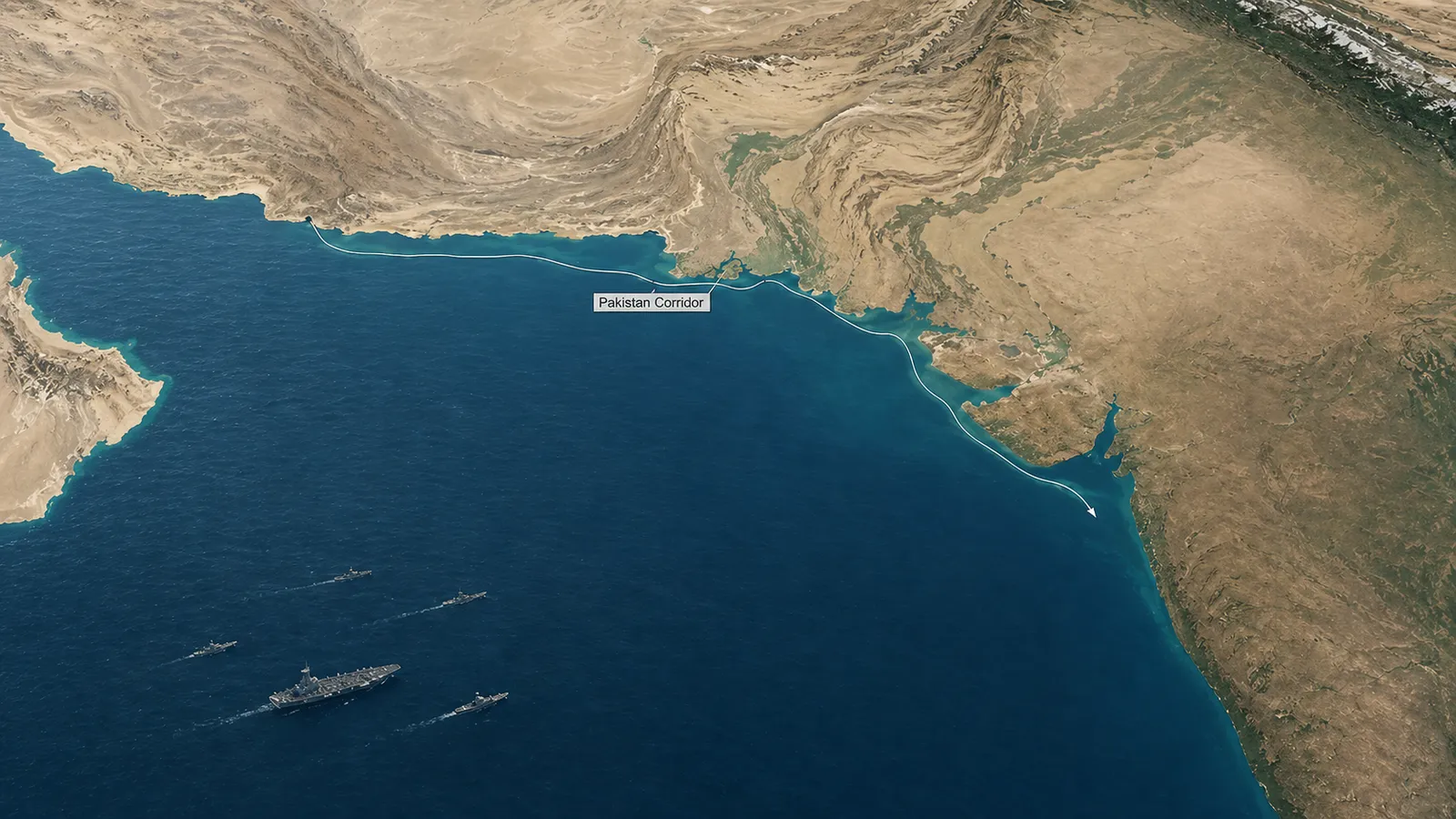
Hole 2: international law. Apart from sanctioned vessels and stateless ships, U.S. forces can only “hail” and “turn back” most Iranian-linked tankers — no direct attack, no boarding, no seizure. This isn’t a “blockade” — it’s a cost-asymmetric cat-and-mouse game. The U.S. burns hundreds of millions per day sustaining three carrier groups. Iran’s dark fleet just turns off AIS and tries another route.
47-Year Immune System
A massively underappreciated fact: Iran’s economy is already conditioned to run at extremely low metabolism.
Oil isn’t Iran’s only lifeline. The Caspian connects to ally Russia. Overland routes link to Turkey, Iraq, and Pakistan — none of which the U.S. naval blockade can touch. Iran is largely self-sufficient in food, has abundant groundwater, and operates a complete refining and petrochemical chain domestically. It isn’t the “one pipe gets cut and we’re done” structure like Saudi Arabia. It’s closer to a besieged but self-sustaining fortress.
On the “forced well shut-in” concern, one key distinction gets ignored: Iran can dial down production gradually, not abruptly shut in.
When the war broke out, Iraqi and Kuwaiti wells were cut abruptly — foreign engineers evacuated, equipment unattended, wells went from full production to zero overnight. Abrupt shut-in is catastrophic for wellbore integrity: past 4–6 weeks, you start losing capacity permanently.
Iran is completely different. NIOC — Iran’s national oil company — has built a fully autonomous engineering team over 47 years of sanctions, with no dependency on BP or Shell. When exports choke and storage approaches full, NIOC can methodically throttle production from 3.5 million bpd down to 2.5–2.8 million bpd while maintaining wellbore integrity. This isn’t “forced shut-in.” This is managed throttling.
Iran’s onshore and floating storage combined offers roughly 180 million barrels of buffer. At current accumulation rates, they have 6–7 months before real tank-top pressure.
47 years of sanctions aren’t Iran’s weakness — they’re its immune system. Every sanction forced it to learn a new way to survive.
The Prize Is Worth the Wait
After establishing can Iran hold out, look at why it wants to.
If Iran grits its teeth until the U.S. withdraws, what does it win?
Permanent control of Hormuz. Iran has already legislated the toll, signed bilateral transit agreements with 9 countries, mined the traditional shipping channel to funnel all legal transits through Iranian territorial waters, and watched China and Russia veto the UN Security Council’s “restore free passage” resolution. This is no longer a “blockade” — it’s a running toll system. At normal flow rates, roughly $15 billion/year. Permanent.
Nuclear weapons. Indefinite ceasefire = zero monitoring. Iran already has 440+ kg of highly enriched uranium — enough for 16 warheads. On the North Korean timeline, full deterrent capability lands around mid-2027.
$15B/year in permanent revenue + a nuclear guarantee of regime survival — this is the largest strategic prize a nation can win. Suffer a few months of economic pain for this prize? Any rational government and population would make the same call.
Iran’s Open Trap
All of the above is “Iran can hold out.” Now the twist: Iran isn’t just holding — Iran is moving.
Over the weekend, Iran’s Foreign Minister Araghchi, during a visit to Pakistan, passed a formal proposal to the U.S.:
Iran will reopen Hormuz first, the U.S. lifts the naval blockade, the nuclear question gets deferred.
At first glance, reasonable. Almost a concession — Iran unilaterally offers to reopen the strait, all it asks is that the U.S. stop blockading, nukes can wait.
But this proposal isn’t meant to be accepted. It’s designed to be rejected.
Iran has constructed a weapon that auto-activates on refusal. Walk through Trump’s options.
Option A: Reject. Rubio already answered for him: “won’t accept any agreement that doesn’t include the nuclear issue.” The moment of rejection flips the narrative:
- Before: Iran closed the strait → holding the world economy hostage → Iran is the villain.
- After the flip: Iran offered to reopen the strait → the U.S. said no → the U.S. is the one blocking peace.
From that moment, global gasoline inflation is no longer “Iran’s fault” — it’s “Trump rejected peace.” The German Chancellor has already publicly said the U.S. has been “humiliated.”
Option B: Accept. More lethal for Trump. Note what Iran’s proposal deliberately omits — whether the “reopened” strait still charges tolls. Iran has already legislated the toll, is already collecting, has signed agreements with 9 countries. So “reopen” = paid transit, not free restoration. And the U.S. lifting the blockade = giving up the last remaining pressure tool. Trading permanent leverage for a vague promise. Even Trump can do this math.
All paths are Iran wins. And the path Iran most wants is rejection.
Then the script plays out. Trump rejects. Rubio publicly refuses. Pakistan — the mediator — dismantles every security checkpoint set up for the talks. Even the table has been taken away.
Simultaneously, Araghchi flies to Moscow to see Putin. The timing is flawless: Trump rejects → Putin immediately declares “Iran offered peace, the U.S. refused” → international opinion tilts further toward Iran.
This is the elegance of an open trap — you can see it, and you still can’t dodge it. Because rejection itself is what Iran wanted. So is acceptance. So is silence. Every option leads to the same endpoint: Iran wins the moral high ground, Trump carries the political cost.
That cost is compounding fast. Today, oil broke $100. U.S. average gasoline hit $4.18 — the year’s high. Summer driving season starts in a month. Every day that passes, Trump has one fewer chip in this game.
Iran doesn’t need to beat the U.S. It just needs to wait for the U.S. to crack itself.
47 years of sanctions taught Iran one thing:
The U.S. needs a result. Iran just needs time.
Next essay: the endgame — why the U.S. most likely declares “victory” this summer and walks away quietly.
If you find factual errors or logical holes in my analysis, call them out in the comments. Let’s push this thought experiment as far as it’ll go.